
Pest control
Bed bug heating equipment
Bed bugs are increasingly resistant to chemical treatments, and some clients just don’t want chemicals — so the equipment, and the process used for a heat treatment, becomes the pest control operator’s secret weapon. After thousands of hours of actual operation, PCOs have found the patented Modular Heat Injector System™ (US Patent 9,459,022) to be a most energy-efficient, heat-focused professional bed bug heater.
A dedicated combustion blower supplies fresh air for the burner, so the heated airflow can be recirculated safely within the space. An industrial blower — powered from a standard home outlet — uses Automatic HP Boost™ to adjust motor speed as flexible duct is added, and an onboard temperature controller modulates the gas (like cruise control) to hold the discharge temperature you choose.
Why operators choose it
- Safe. Plugs into any standard home outlet. The electrical controls are UL Listed. The Flame Management System controls the redundant gas valves, starts the burner and continuously monitors the flame.
- Simple. One switch enables the airflow, another enables the heat — then it operates automatically at the operator’s chosen discharge temperature.
- Effective. Once the space is above the lethal temperature for bed bugs, pressurization forces heated air through electrical sockets and other openings in the structure.
- Energy efficient. The main airflow is recirculated and 100% of the heat goes into the space, with only a small volume of outside air used for combustion.
- Powerful. Puts more heat into a treatment than the largest electrical systems or tube-style heaters that consume significantly more fuel.
- Discreet. Sits in an outside doorway, or inside the heated space with the Air Shell. No generator, boiler or external duct to draw attention to your client.
- Single operator. The modular design goes anywhere, and the whole treatment can be run by one person.
Specifications
| Heat output | Up to 389,000 Btu — a 90°F rise at 4,000 CFM, equivalent to 114 kW of electrical power |
|---|---|
| Temperature rise | 3 to 90°F at full airflow; reduce airflow for a higher rise |
| Discharge temperature | Adjustable from the control panel, up to 160°F; held within ±1°F at any airflow. Components rated to 180°F, with supervisory limits on the setting |
| Power | Typical 15-amp house outlet powers a 240 V, 3-phase, Premium Efficiency 1.5 HP inverter-duty TEFC motor with soft start and stop |
| Airflow control | Automatic HP Boost™ adjusts motor speed to the flexible-duct layout; volume set with a knob |
| Fuel | Propane from dual tanks through a gas manifold; gas hose can run up to 400 ft |
| Flame safety | FM-approved Flame Management System; flame rod with 1-second response to loss of flame; direct spark ignition with manual reset outside the panel |
| Other safety | Independent high-temperature limit (auto reset); redundant gas valves; keyed access to the control panel and burner controls |
| Placement | Motors and controls stay outside the heat — in an outside doorway, or inside with the Air Shell |
The heat treatment process
- Move the Heat Injector to the infestation and position it in an outside doorway, or inside the heated space with the Air Shell installed to isolate the motors and controls.
- Plug it into any standard outlet.
- Attach flexible duct to the discharge with fabric connectors and run it to the remote locations. Test the duct at maximum air volume.
- Connect the gas hose with its quick-disconnect fitting to the Heat Injector and the Gas Manifold, which is fed by regulators on dual tanks. Indoors, the gas hose runs through the duct that supplies outside air.
- Turn on the Airflow and Heat switches, set the discharge temperature and adjust the airflow to maximum.
- Install doorway drapes so the coolest air leaves each room at the floor, and the Doorway Air Barrier around a unit in an outside doorway.
- Monitor the Air Intake temperature and sensors in the space. During inspections, move the duct to new discharge locations; optional fans speed up the heat transfer.
- When the Air Intake passes about 125°F, open the Pressurization Gate and drop the Damper to force heat into cracks and openings where bed bugs hide.
- Heat until the structure and its contents reach lethal temperatures for bed bugs and their eggs.
- Purge: draw fresh air in to push the heated air out — usually without heat while the gas lines are packed — until the building’s HVAC can take over.
Distribution system
Flexible Mylar duct and fabric duct connectors carry heated air to several locations at once. A 3-port connector attaches to the discharge with Velcro for up to three distribution legs, and each leg can be split into two or three more. Connectors also shorten duct sections and act as end-of-duct restrictions to balance the airflow. The DC-90 duct concentrator discharges heat through 90 inches of openings, forcing it under heavy furniture and along baseboards. The duct can be moved during a treatment, and clutter doesn’t get in the way.
Maintenance
No specific maintenance is required. Check the blower belt’s tension through the air inlet now and then, test the redundant valves annually, record the flame rod test voltage to spot a weakening signal, and inspect the igniter annually. A detailed Owner’s Manual is supplied with every purchase, and the modular design makes repairs easy.
Accessories
- Fabric duct connectors: CC-16 and CC-12 cinch connectors, DC-90 duct concentrator, Y3-1612 3-port splitter, Y-1616 and Y-1612 “Y” splitters, DD-316 and DD-16V main discharge connectors
- Air Shell, Doorway Air Barrier with three doorway drapes, Trailer Docking Assembly
- Gas Manifold with dual regulators, inline QD gas gauge, 3/8″ and 1/2″ gas hoses from 15 to 200 ft
Applications
Where operators have used it
- A 35,000 sq ft call center, treated in 48 hours with two Heat Injectors
- A shoe store and its warehouse
- University housing and homeless shelters
- Motor homes and semi-trucks with sleeper cabs
- Water park suites; hotels, motels and cabins
- Residential homes of any size, commercial properties and nursing homes
- Supplemental heat for the water restoration process
Bed bug operators
In their words
“We (like most) aren’t made of money... however we went with the Heat Injector (David Krupp). In the last month we have performed several treatments but 4 treatments were larger than 3000 sq ft. The unit we went with was able to heat 3,000+ sq.ft. without any issues, 2 of the homes had 3 different floors. This is a propane heater with a VERY powerful fan pushing the heat throughout the home. The value we have been able to receive from a unit like this, and deliver a 100% success rate with our customers, is an all around win! I am all around impressed with this unit. 40 lbs total usage of propane on a 3,107 sq.ft. home. Talk about EFFICIENCY!!”
Mike Fillion NC Pest Control, NC
“With this system, you can get more work with it, because your costs are lower, so therefore your price can be lower than the competition. Add the fact that you don’t break or melt things inside, I’d say that you have the recipe for a moneymaker! My machine has paid for itself 3 times over in just the first 9 months!”
Joseph Wilson All Pro Pest, CA
“I have a Heat Injector System for almost 3 years now. It isn’t a cheap system, but it works so well. I bought a cheap diesel unit heater from a friend because it was a great deal also. It’s decent, but unless my Heat Injector is already on a job, I never use the diesel unit. Comparing them both, it isn’t even close. If I add another heater to my arsenal, I’ll add another Heat Injector. To me, if you’re doing a lot of bed bug work, the price isn’t a big issue. You’ll make it back, and end up with an extraordinary heater in the process.”
Jason Murphy Optimus Pest Solutions, TN

HVAC & process
Direct-fired duct heater
Direct gas-fired heat with a dedicated combustion blower lets airflow stay adjustable and reduces load on the main blower — about 30% less energy to move the same air when compared with typical heater static loads that never go away.
Heat only the volume you need. The result is clean enough for many recirculated systems, and compact enough to drop into a wide range of equipment. The module handles the elements and can be mounted in virtually any position around a duct — top down, bottom up, or side to center.
Recent duct heater projects
- Two 1,000 MBH Heat Injector duct heaters for two steel drying chambers for plaster molds — SSI designed the sheet metal structures too, and they were erected from SSI’s assembly instructions.
- A 400 MBH duct heater for a paint drying chamber, again with an SSI-designed enclosure.
- A 400 MBH unit for a greenhouse that needed heat after a cooling coil: a bolt-together vestibule inside the air handler forces air through the injection chamber and straight into the main blower. Yields of tomatoes increased with the warmer temperatures and the carbon dioxide from the recirculated, low-PPM heat. A 10 ft plug-in whip lets the control panel sit near the ground for easy access.
- A greenhouse operation in Dallas, TX, where the airflow is heated and dehumidified at the same time.
- A 20-year-old prime coat curing chamber converted from wall-mounted infrared heat. It used to struggle to reach 120°F; it now heats to 145°F for a more thorough cure, and the customer later converted its top coat chamber as well.
- Paint drying and plaster mold drying chambers, with the Heat Injector mounted on top of the recirculated airflow where moisture-laden air is exhausted.
Every Heat Injector is pre-tested at SSI’s facility, so startup is always a breeze.
Make-up air
Heated make-up air system
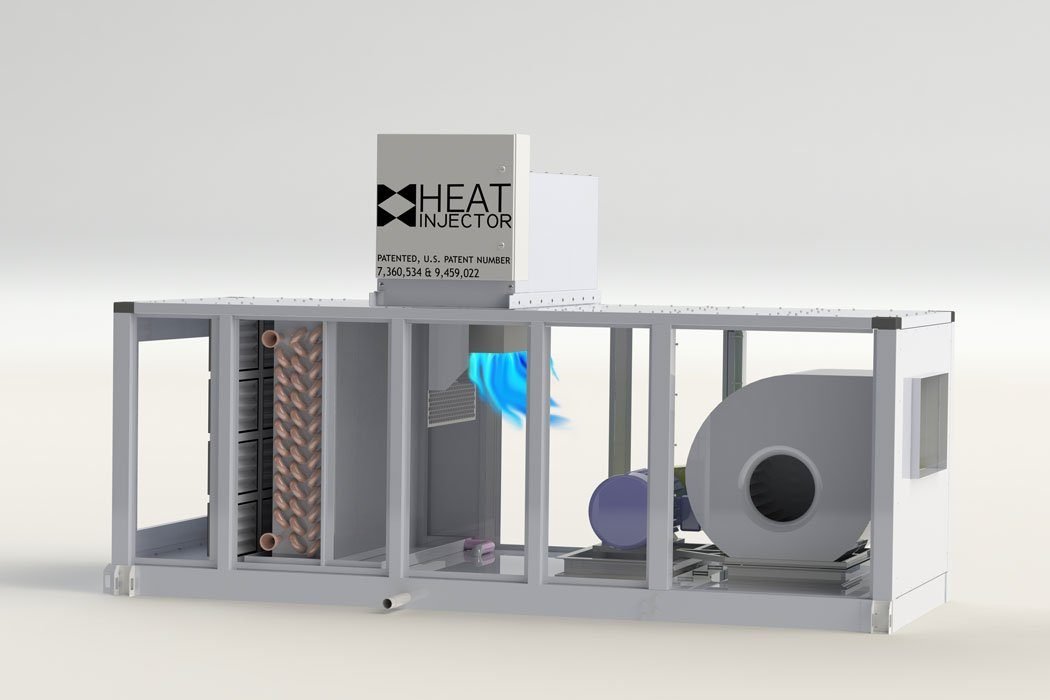
When air is exhausted, an equal volume must return. The Heat Injector System pairs the right air handler with a Heat Injector positioned to hit your discharge temperature — in any size, across a large range of airflow and heating capacity. Removing profile plates and the static load from the main air mover brings large electrical savings, and gas use drops significantly compared with indirect-fired heat.
Modules are also supplied to systems houses that need to add heat to equipment they manufacture — no static load, variable airflow.
How ordering works
Ordering starts with the heated air make-up selector. It asks the questions needed to reach a budgetary quote for your project; once enough is known, more questions refine the design and the total. You can work directly with SSI’s engineers to customize the equipment, with several interface options.
Orders can be upgraded with Field Startup, Jobsite Commissioning and Maintenance Team Training.
Heated air makeup for Honda
Honda needed 6,000 MBH of heat in its rooftop units. SSI designed a custom insert that was installed in a Trane air handler, Honda had a video made of the equipment startup, and SSI trained Honda’s maintenance team on the new equipment.
Building pressure
Southern Breeze™
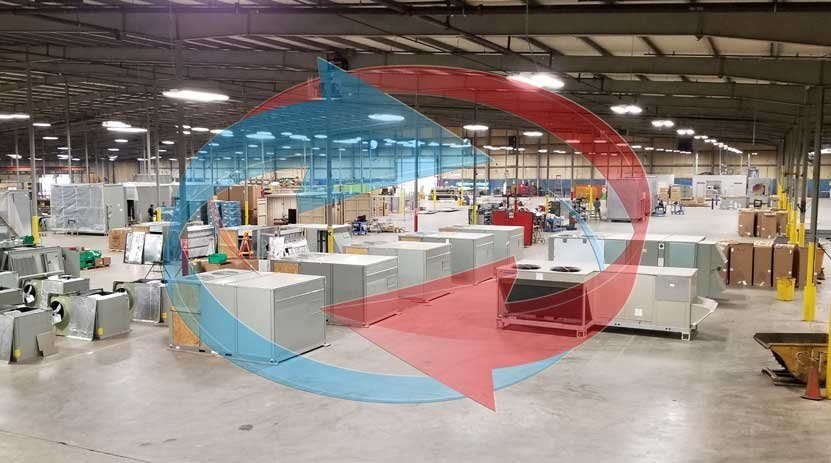
Negative buildings with closed doors and active exhausts struggle in cold weather. Southern Breeze™ injects heat into intake airflow through an injection chamber so entering air feels warm — a low-energy approach with site-specific safety controls.
Note: negative buildings hurt exhaust performance, and indirect heaters in the space are often about 20% less efficient under those conditions.
Need a selector run?
Share your airflow, temperature, and fuel constraints — we’ll help size the application.